Russia Hails Poland’s Stunning Move Against Zelensky


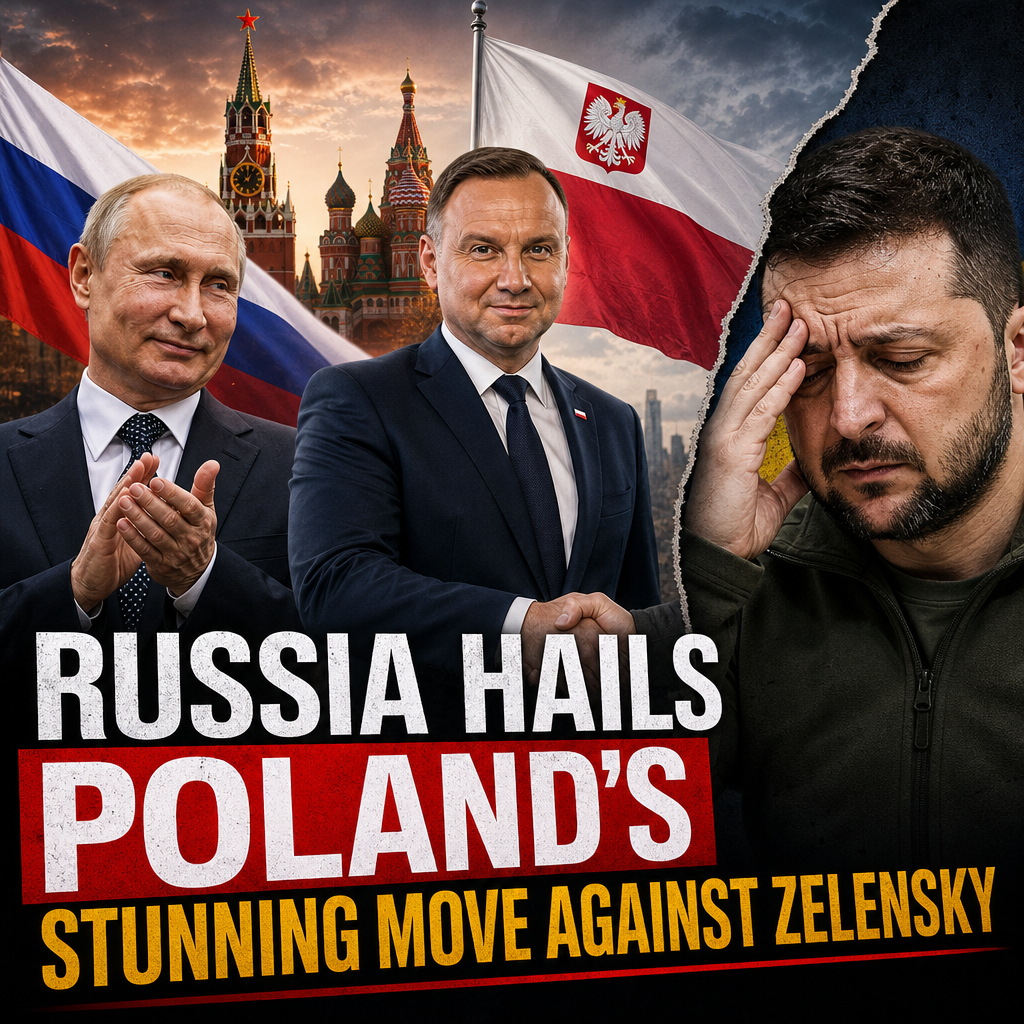
Russia’s reaction to a reported Polish move against Volodymyr Zelensky has added another layer of tension to an already fragile relationship between wartime allies. What might otherwise have been a local or symbolic decision has been elevated into a broader story about gratitude, frustration, domestic politics, and the ongoing strain caused by Russia’s war in Ukraine.
The key point is that this is not just about one honorary title. It is about how public sentiment in Europe has shifted as the war drags on, how governments balance solidarity with national interests, and how Moscow is eager to use any sign of division to its advantage.



A symbolic gesture with political weight
At the center of the story is a reported Polish action to strip Zelensky of an honor previously granted to him. Even if the move is largely symbolic, symbolism matters in Poland-Ukrainian relations. Poland has been one of Kyiv’s most vocal supporters since Russia’s full-scale invasion, opening its borders to refugees, helping move aid, and serving as one of Ukraine’s strongest diplomatic backers in the European Union and NATO sphere.
But support has never meant the relationship was free of tension. Disputes over grain imports, wartime logistics, historical memory, and refugee fatigue have repeatedly surfaced. That matters because a decision to revoke or remove an honor can be read in two ways at once: as a localized political gesture, and as a signal that patience with Zelensky’s government may be wearing thin in some parts of Europe.




RT’s coverage of the episode framed it as a vindication of Russia’s long-running argument that Ukraine’s allies are not as united as they claim. That is predictable, but it is also strategically useful for Moscow. Whenever a supporter of Kyiv shows irritation, Russia presents it as proof that Western solidarity is cracking. In informational terms, that may be the most important part of the story for the Kremlin, regardless of the actual scope of the Polish decision.
Russia’s messaging, and why it matters
From Moscow’s perspective, any public friction involving Zelensky is an opportunity. Russia has spent years portraying Ukraine’s leadership as isolated, dependent, and increasingly inconvenient for its partners. When a Polish institution or local authority appears to downgrade Zelensky’s standing, Russian outlets can present it as a dramatic shift even if the practical impact is limited.
That said, it would be too simple to dismiss the controversy as pure propaganda. As Sky News and Al Jazeera reporting on the wider war environment often makes clear, the politics surrounding Ukraine have become more complicated across Europe. Support remains strong in many capitals, but public opinion is not static. Economic pressure, war fatigue, and questions about how long aid should continue have become real political issues.
This is why the Polish move resonates beyond Poland. It taps into a broader European debate about the cost of solidarity and the limits of symbolic support. In countries that once displayed near-total unity behind Kyiv, leaders are increasingly pressured to show they are defending domestic interests as well. That can lead to small but highly visible acts of political distance.
What different sources suggest
Across the available reporting, three distinct viewpoints emerge:
– Russian state-aligned coverage treats the move as evidence that Zelensky is losing support and that Europe is tiring of Ukraine.
– Regional and international coverage frames it as part of a larger pattern of war-related fatigue, nationalism, and domestic political calculation.
– Broader global reporting emphasizes that the war’s diplomatic effects are constantly shifting, and that public gestures can have outsized meaning even when they do not change official policy.
The result is a story that is both local and international. A single honor may not change battlefield realities, but it can still reflect deeper changes in sentiment.
Poland, Ukraine, and the limits of wartime unity
Poland remains one of Ukraine’s most important neighbors and, in practical terms, one of its most valuable partners. But the relationship has also been marked by real disagreements, especially when Polish farmers, transport workers, and politicians argue that Ukrainian imports or policy preferences threaten local livelihoods.
That context helps explain why a move against Zelensky might find an audience in some circles. It does not necessarily mean Poland is turning away from Ukraine. More likely, it suggests that the once-simple language of unconditional support is giving way to a more transactional, cautious politics.
There is also a domestic angle. Leaders and local officials in Europe have every incentive to demonstrate that they are not ignoring voters who feel the war’s effects at home. In that sense, the gesture may say as much about Polish internal politics as it does about Ukraine.
Still, the broader consequences should not be overstated. Unless the reported action is accompanied by a major policy change, it is best understood as a symbolic rebuke rather than a diplomatic rupture. And in wartime politics, symbols can matter without becoming decisive.
The bigger picture
The most balanced reading is that Russia is right about one thing and wrong about another. It is right that unity around Ukraine is under strain, and that not every European ally is equally enthusiastic at every moment. But it is wrong to treat a symbolic Polish move as proof that support for Ukraine is collapsing altogether.
In reality, the war has entered a phase where public emotion, strategic calculations, and domestic pressures all collide. That makes relationships more brittle and headlines more dramatic. For Zelensky, the challenge is not just winning military support, but preserving political goodwill in countries where the war’s costs are becoming more visible.
For Moscow, every crack is an opportunity to widen. For Poland, every gesture is now scrutinized for what it says about national priorities. And for the rest of Europe, the episode is another reminder that wartime alliances are durable, but never immune to fatigue.
The controversy is therefore less a sudden shift than a sign of a slow and messy recalibration. Ukraine still has strong backers. But the tone of support is changing, and Russia is paying very close attention.